GRA 4164
<!-- .slide: class="title-slide" --> <p class="kicker">GRA 4164 · Lecture 9 · Fall 2026</p> ## LLM Input/Output,<br>Training, and Fine-tuning ### Leif Anders Thorsrud & Vegard H. Larsen — BI Norwegian Business School --- <!-- Section A — Opening --> <!-- .slide: class="big-statement" --> You know the architecture. Today: where the **weights** come from. …and how to make someone else's weights work for **you**. <!-- .element: class="muted" --> --- <!-- Section 01 — Input to output --> <!-- .slide: class="section-divider" data-background-color="#282828" --> <p class="kicker">01</p> ## From tokens to the next token --- ## The full stack 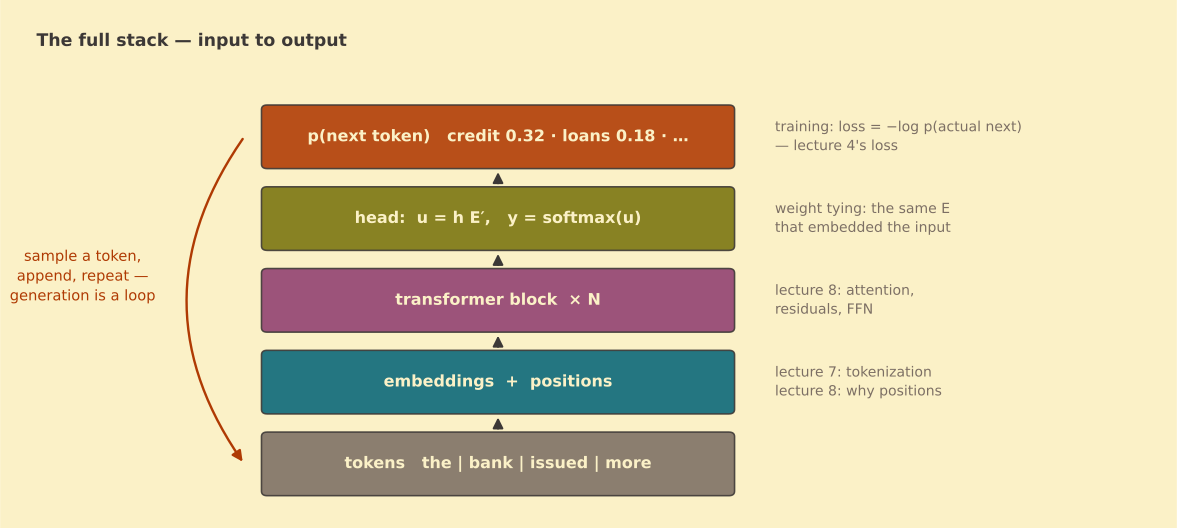 --- ## How much fits? The context window - $N$ is **finite** — attention cost and memory grow fast with length - BERT era: **512** tokens · today: **hundreds of thousands** - Overflow → silent **truncation** or an error: know which your tool does --- <!-- Section 02 — Generation --> <!-- .slide: class="section-divider" data-background-color="#282828" --> <p class="kicker">02</p> ## Picking the next token --- ## The distribution is not a decision - **Greedy** (always argmax) → generic, repetitive text - **Pure random** over everything → nonsense from the long tail - **Top-k**: sample within the k most likely — but the right k varies - **Top-p**: sample within the smallest set covering probability p --- ## Temperature $$\boldsymbol{y} = \text{softmax}(\boldsymbol{u} / \tau)$$ 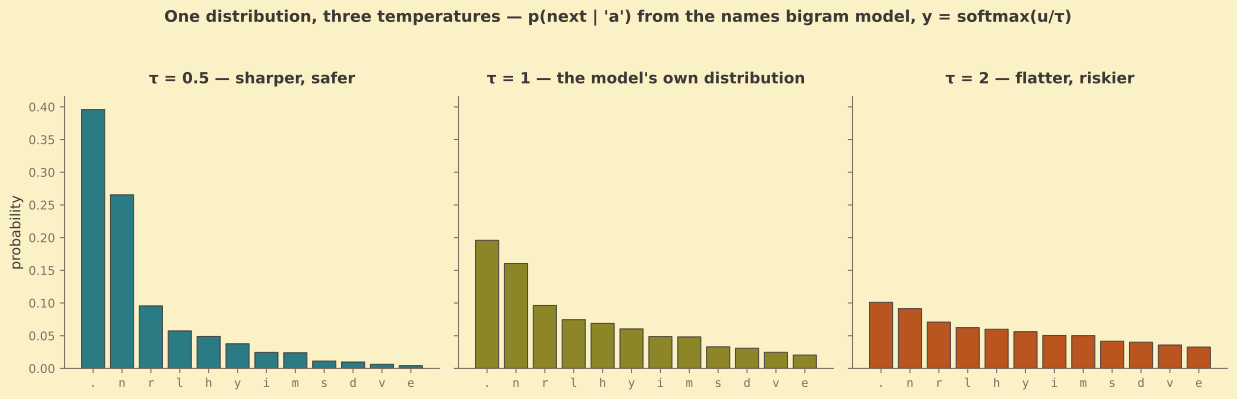 --- <!-- Section 03 — Training --> <!-- .slide: class="section-divider" data-background-color="#282828" --> <p class="kicker">03</p> ## Training --- ## The loss, one more time $$L\_{CE}(\hat{y}\_t, y\_t) = -\log \hat{y}\_t[w\_{t+1}]$$ - **Self-supervised**: the next word in real text *is* the label - Sequence loss = the **average** over positions; **teacher forcing**: condition on the true history, not the model's guesses - The same loss since **lecture 4** — third and last appearance --- ## Gradient descent 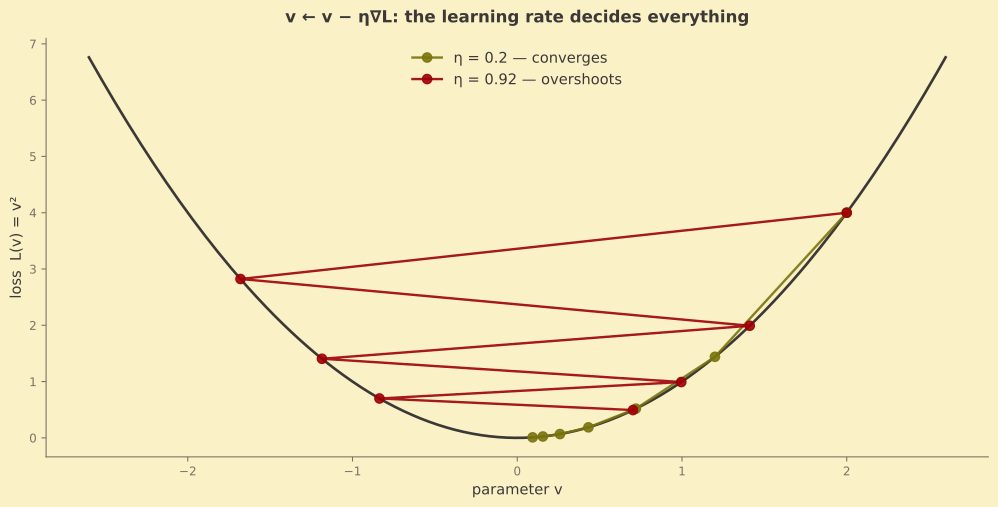 --- ## Backpropagation: where gradients come from - The network is a **graph of simple operations** - Chain rule, applied **backwards** through the graph: every parameter's gradient in **one backward pass** - You've used it: `loss.backward()` in the lecture-4 notebooks --- ## Making it scale: SGD - **Mini-batches**: estimate the gradient on 32–4M tokens, not the whole corpus - **Epoch** = one pass over the data; **shuffle** between epochs - Noise is a feature — helps generalisation; **Adam** & friends adapt η per parameter --- <!-- .slide: class="big-statement" --> Pre-training is **industrial**. Adapting is **affordable**. The rest of the lecture is the affordable part. <!-- .element: class="muted" --> --- <!-- Section 04 — Adapting a pre-trained model --> <!-- .slide: class="section-divider" data-background-color="#282828" --> <p class="kicker">04</p> ## Adapting a pre-trained model --- ## Transfer learning - A model pre-trained on *everything* already encodes language, facts, style - **Fine-tuning**: keep the body, retrain for *your* task - Update **all** weights, or just the **new parts** — a cost/quality dial --- ## Route 1: bolt on a task head - Replace the language-model head with a **classifier head** - Example: sentiment — sequence embedding → softmax(positive / negative) - Needs **labelled data**; train the head (and optionally the body) with SGD --- ## Route 2: teach it to follow instructions - **Instruction tuning (SFT)**: fine-tune on curated instruction → response pairs - **RLHF**: humans rank outputs → reward model → optimise against it - Newer: RL on **verifiable rewards** — math, code, tests → reasoning models - This — not pre-training — is what turned text-completers into **assistants** --- ## Route 3: barely touch it - **LoRA / PEFT**: freeze the body, train tiny low-rank add-ons — fine-tuning on one GPU - **Feature extraction**: use the model's **embeddings** as inputs to your own model - **Prompting**: adapt with **no** training at all → lecture 11 --- ## Whichever route: how do you know it works? - A **golden set** — held-out examples with known good answers, before you start - **Metrics where you can**, human or **LLM-as-judge** review where you can't - **Audit the errors**, not just the score — *which* cases fail, and why? The train/validate/test discipline from lecture 3 — it never went away. <!-- .element: class="muted" --> --- <!-- .slide: class="big-statement" --> ## Questions -- ## Positional encodings, the original recipe $$PE\_{(pos, 2i)} = \sin\!\left(\frac{pos}{10000^{2i/d}}\right) \qquad PE\_{(pos, 2i+1)} = \cos\!\left(\frac{pos}{10000^{2i/d}}\right)$$ - Unique per position; relative offsets are linear functions of each other - Extends beyond training lengths; modern models often **learn** positions instead -- ## Backpropagation, the algorithm - Feedforward: $z^{l} = w^{l} a^{l-1}$, $\;a^{l} = \sigma(z^{l})$ - Output error: $\delta^{L} = \nabla\_a L \odot \sigma'(z^{L})$ - Backwards: $\delta^{l} = \big((w^{l+1})' \delta^{l+1}\big) \odot \sigma'(z^{l})$ - Update: $w^{l} \leftarrow w^{l} - \frac{\eta}{m} \sum\_x \delta^{x,l} (a^{x,l-1})'$ -- ## Encoder–decoder and cross-attention $$\text{CrossAttention}(Q, K, V) = \text{softmax}\!\left(\frac{QK'}{\sqrt{d\_k}}\right)V \quad \begin{aligned} Q &= W^Q H^{dec} \\\\ K, V &= W^K H^{enc},\; W^V H^{enc} \end{aligned}$$ - The original transformer: encoder reads the source, decoder writes the target - Queries from the **decoder**, keys/values from the **encoder** — translation's workhorse --- ## What's next - **Lecture 10 (Tue): practical day 2** — pre-trained models hands-on; **bring a laptop** - Course-server access details come with the practical-day materials - Reading: J&M chapters 8–10 · finish **HF course ch. 1–3** if you haven't